
Geodiversity Day 2025 at the Cliffs of Fundy UNESCO Global Geopark

In this guest article Tim Fedak outlines how the Cliffs of Fundy UNESCO Global Geopark, Nova Scotia, Canada celebrated International Geodiversity Day 2025 with a very special guided hike.

Photo of sunrise by Laurie Currie, Local Guy Adventures.
In the predawn light of October 6, 2025, a small group has assembled on the shore of the Nova Scotia's Bay of Fundy to watch the sunrise. We gather at the small coastal village of Spencers Island in the Cliffs of Fundy UNESCO Global Geopark (http://fundygeopark.ca) to celebrate International Geodiversity Day. Known as Wtuoml (his pot) by the Mi’kmaq, the village and place are named for the small island we see just off the coast.

Watching the sunrise connects this present moment with our ancient past. As dawn approaches, the cool air carries aromas of salt water and marine life as seagulls laugh along the distant low tide shoreline. The night’s stars slowly dissolve into shades of orange and mauve. When the sun’s orb finally breaches the horizon beside Cape Split, its radiance warms our smiling faces and the 300-million-year-old rocks behind us.
With the sun rising further into the sky, our group begins to walk along the shore to examine the 300-million-year-old rocks. A map published by the Geological Survey of Canada in 1905 includes a symbol marking the location where fossil footprints were observed by geologists in the 1880s. This morning, we are retracing these historic and fossil steps.
As we walk along the shore, dried seaweed and modern seashells lay scattered among the rounded beach cobbles. Picking up a shell, we can count the growth rings, each representing a year of life, records of many recent sunrises. The beach cobbles, rounded smooth from bouncing against each other as the waves roll in during high tide. With each tumble the cobbles become ever so much smaller, slowly eroding into smaller pebbles and sand. We wonder, how long will it take for these beach cobbles to erode away completely? How long have they been lying on this shore? A thousand years?
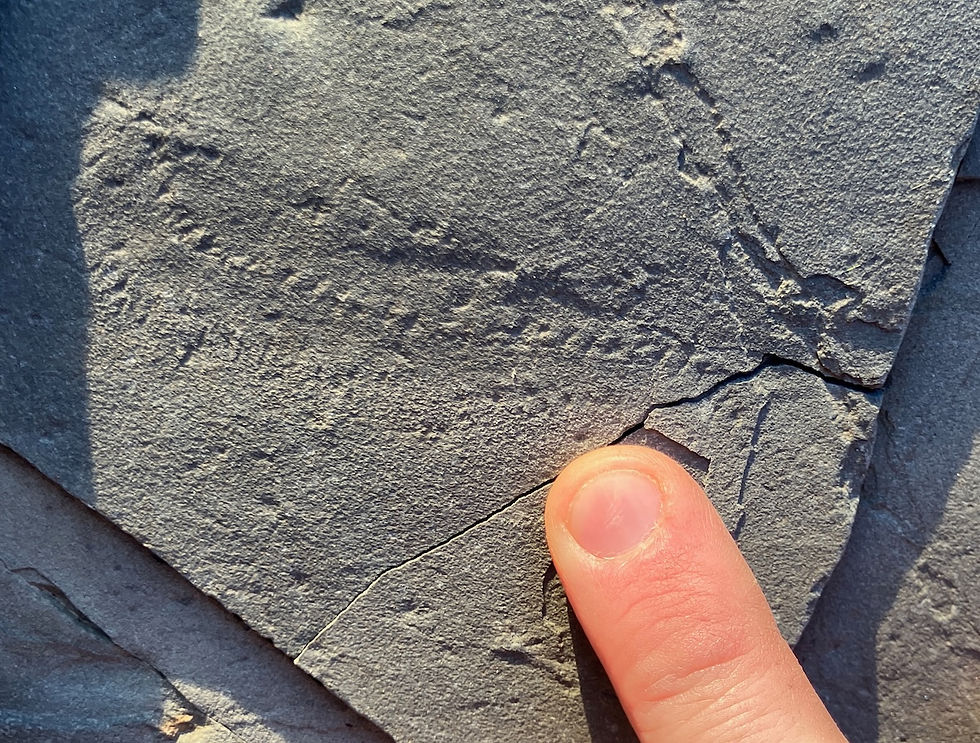
When we arrive at the rock outcrop the special light of early morning reveals the ancient traces on the surface of the rocks. With excitement and glee our group observes ancient fossil footprints of ancient arthropods like millipeds (Diplichnites) and horseshoe crabs (Kouphichnium) in the 300 million-year-old Carboniferous aged rocks. Imagine these animals walking across the muddy surface and watching an ancient sunrise.
The tide was low at sunrise but has been rising during our walk along the beach. These Bay of Fundy tides are some of the highest in the world and pulse along this shoreline twice a day. Having finished our morning beach walk, we head out to our next destination on the far end of the Geopark, to watch the tidal bore arrive at the Fundy Discovery Site near Truro.
An October drive in the Geopark provides wonderful views of wild blueberry fields turned red and stunning fall foliage. These are some of the best places to see the fall colours, especially along the road around Moose River and views from Economy Mountain. The fields and forests vibrate with vivid colours or orange and red, as if the leaves are recalling the memory of the past summer’s warm sunlight.

Arriving at the Fundy Discovery Site, a large group of locals and tourists have already gathered. And hundreds of migrating Canada Geese as well. Then a cacophony of honks and excitement erupt as the geese complain as the tidal bore rolls up the Salmon River. The Bay of Fundy is home to the world’s highest tidal range. Pulled and powered by the moon the wave of tide flows by. Soon after, the tide will begin to fall again and the Geese will return to their restful bobbing along the shore.

The excitement over, we then head back west into the geopark, following the sun and the falling tide. Our next destination is Five Islands Provincial Park, to watch the sunset in six and a half hours. The rocks at Five Islands are 200 million years old. There are basalt cliffs that formed from cooled magma that poured out onto the earth’s surface when the supercontinent Pangaea began to rip apart. On top of the basalt, vibrant red sandstones contain the bones and footprints of Canada’s oldest dinosaurs.
Our group assembles on the beach at Five Islands and quickly determine a place in the mudflat where we will draw a large geopark logo. A 12-meter-long rope measures out the arcs and circles of the logo, and then we use rakes to fill in the pattern of the logo. The sun casts long shadows behind us as we watch the sky turn red, as we look at the Geopark logo that points toward the setting sun.

After the sun has set, several of us begin looking at the sandstone boulders along the shore. We gaze down with amazement to see a large dinosaur footprint on one of the boulders. An ancient dinosaur had walked along a mud channel 200-million-years ago, its dried footprint then quickly filled with sand.

With the sky still ablaze in the colours of sunset an ancient footprint offers the presence of a dinosaur to our celebration of International Geodiversity Day. Our hands reach out and connect across geological time. A perfect ending to a perfect day in the Cliffs of Fundy UNESCO Global Geopark.
Learn more and plan your visit:
-----
Article originally published in the Geologists’ Association Magazine, Dec. 2025.
Dr. Tim Fedak is the Senior Curator of Geology of the Nova Scotia Museum and Adjunct Professor at Dalhousie University Earth and Environmental Science. Fedak has been involved in the Cliffs of Fundy UNESCO Global Geopark since it was established (2020).


It is so lovely how you have woven Indigenous place-based knowing alongside geological, agricultural and historical concepts and observations into this beautiful narrative to bring to life these Geopark moments.
What a fantastic way to end the trip - finding that footprint as the sun set!